


Particle Board
Yinhao Import&Export:Your Professional Particle Board Manufacturer!
Yinhao Import & Export Co., Ltd. began producing plywood in 2007. After 18 years of development, the company now operates three factories: a plywood plant, a new materials plant, and a veneer plant. The company covers 36,000 square meters, employs 86 people, and has an annual production capacity of 60,000 cubic meters.


Why Choose Us
Quality Assurance
The company strictly adheres to industry quality system standards and specifications, using industry-leading testing equipment to ensure product quality and maintain a strong reputation.
Affordable Prices
We have a professional procurement and cost accounting team dedicated to reducing costs and maximizing value, allowing us to offer you competitive prices.
Professional Service
Yinhao has three sales teams and two inspection teams providing 24/7 service. If you encounter any issues with our products, we will respond quickly and offer full support.
OEM/ODM Services
When you request a solution, our engineers will provide a faster and more complete customized plan. We offer a wide range of products and technical support tailored to your specific needs, ensuring you select the right product.
Product Specifications
|
Product name |
Particle Board |
|
Material |
Eucalyptus/poplar/hardwood/pine or combi |
|
Thickness |
9mm-25mm |
|
Size |
1220mm*2440mm/1220*2745mm/1220mm*3050mm/as Request |
|
Color |
All kinds of wood grain colors and solid colors/ customisable |
|
Glue |
P2/E0/E1/E2 |
|
Moisture Content |
6%-8% |
|
Density |
630-650kg/m3 |
Advantages of Particle Board


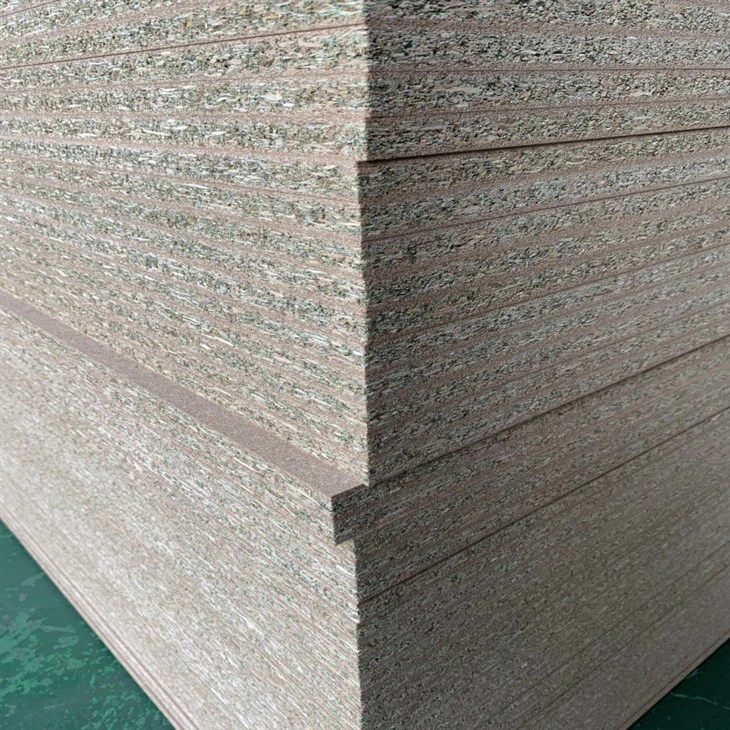
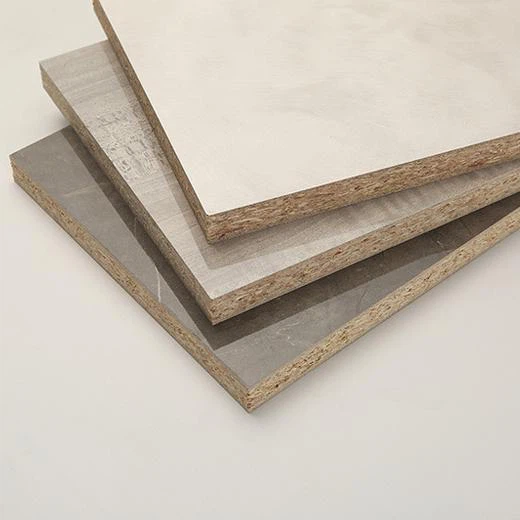
Versatility:
Particle boards can be used in various applications, including furniture, cabinetry, flooring, and wall paneling. They can be easily cut, shaped, and drilled to meet specific design requirements.
Stability:
Particle boards have excellent dimensional stability, meaning they are less prone to warping or shrinking due to changes in humidity or temperature. This makes them suitable for areas with high moisture levels, such as kitchens and bathrooms.
Easy Installation:
Particle boards and lightweight and have consistent composition. It makes them easier for you to cut and shape compared to plywood or solid wood. Moreover, particle boards are very easy to install. You can speed up the construction process and will not require any specialized tools to work with the particle boards.
Lightweight:
Particle board is made from wood chips, sawdust, or sawmill shavings. These particles are bonded together in a synthetic resin or binder. These lightweight materials make the board easy to handle and transport.
Affordable Cost:
Particle board stands out as a more affordable option when compared to solid wood boards or Medium-Density Fibreboard (MDF) boards, constituting one of its main advantages. The lower price makes it an attractive option for consumers with limited budget.
Environmentally Friendly:
Particle board is considered an eco-friendly wood material that is made from recycled wood materials. In the production process, it emits very few greenhouse gas emissions, which reduces the carbon footprint compared to the other materials.
Uniform Properties:
The production process of particle board ensures that its properties and characteristics remain uniform throughout the sheet. This means that when you buy particle board, you can rest assured that there will be no imperfections or differences in texture or quality between different sheets.
Easy to Work With:
Particle board has excellent machining characteristics and can be easily cut, milled or drilled into the desired shape without causing undue stress on the manufacturing equipment.
Application of Particle Board
Cabinets: Particle board is commonly used in kitchen, bathroom, and storage cabinets. When laminated with melamine or other materials, it offers a durable and aesthetically pleasing surface, making it perfect for mass-market cabinetry.
Desks and Tables: Office furniture, including desks, tables, and workstations, often utilize particle board as a core material, with a decorative laminate or veneer finish.
Bookshelves and Storage Units: Due to its affordability, particle board is frequently used for shelving units and bookcases in both residential and commercial spaces. Its consistency in thickness allows for easy production of shelves in different lengths and widths.
Subflooring: Particle board is often used as a subfloor material in residential and commercial buildings. While it is not as durable as plywood, it provides an inexpensive alternative in areas that will later be covered by tile, carpet, or other floor finishes.
Wall Panels: Particle board is used for interior paneling and wall systems in homes and commercial buildings. It is often employed in temporary partition walls in office spaces and retail settings.
Roofing Underlayment: In some cases, particle board serves as underlayment for roofing systems, particularly when a more durable material like plywood is cost-prohibitive.
Pallets: Particle board is widely used to produce pallets for the transport of goods. While not as strong as wooden pallets, particle board pallets are lightweight and cost-effective, often used for transporting less heavy or fragile goods.
Shipping Crates: In some commercial shipping applications, particle board is used to build shipping crates. This material is often used for lightweight or lower-cost shipping needs but may be reinforced with additional materials for higher strength.
In commercial construction, particle board is frequently used as a floor underlayment. It provides a smooth, even surface that can support a variety of flooring materials, including vinyl, tile, and carpeting.
Particle board’s ability to be veneered, laminated, or coated with a decorative surface makes it an attractive material for architectural panels and decorative elements in commercial settings.
Types of Particle Boards
Single-layer Particle Board:
Particleboard with a single layer is made out of wood particles of the same size that have been crushed together. It is a dense, flat board that can be veneered or plastic laminated but cannot be painted. This sort of particleboard is water-resistant but not waterproof. Particleboards with a single layer are ideal for interior use.
Three-layer Particle Board:
A layer of large wood particles sandwiched between two layers of small, dense wood particles makes up a three-layer particle board. The outer layer contains more resin than the inner layer. Three-layer particleboard has a flat surface that is suitable for painting.
Graded-Density Particle Board:
A layer of coarse wood chips is included in the graded-density particleboard. Two layers of fine wood particles are placed between this layer and the next. Particleboard of this type can be used to make wooden furniture and cabinets.
Melamine Particle Board:
A sheet of melamine-impregnated decor paper is glued to the top surface of the plain particleboard using heat and pressure in this form of particleboard. To bond the particleboard and make it water-resistant, melamine-urea formaldehyde resin is used with wax emulsion.
Cement-bonded Particle Board:
This board uses cement as a bonding agent and is moisture, fire, and rot-resistant. Cement (60%), wood waste particulates such as wood chips, sawdust, and wooden shavings (20%), and water are used in the production of cement-bonded particleboard (20%). These boards are more durable, fireproof, and termite resistant due to the cement content.
Laminated Particle Board:
Particleboard with a laminate sheet on the surface is referred to as laminated particleboard. Particleboard gains improved aesthetics and durability with the addition of the laminate sheet.
Veneered Particle Board:
A thin slice of wood known as the veneer is attached to the surface of the veneered particleboard. Veneered particleboard seems like real wood. In addition, as compared to normal particle board, veneered particleboard is more resistant to warping.
Manufacturing Process of Particle Board
Raw Material Collection:
The wood particles, which can include sawdust, wood chips, and even recycled wood, are gathered from various sources.
01
Wood Fiber Preparation:
The raw materials are processed and ground into fine particles or chips.
02
Mixing with Resin:
The wood fibers are mixed with a resin (often formaldehyde-based) to bind them together. Additional chemicals may be added to enhance properties like moisture resistance and strength.
03
Pressing:
The mixture is placed into large presses where it is subjected to high pressure and temperature, forming a solid sheet.
04
Cutting and Finishing:
The boards are then cut to size and finished with sanding or lamination for smoothness and aesthetics.
05

Packaging and Shipping

FAQ